



Understanding the Carbon Border Adjustment Mechanism (CBAM): Implications for the petrochemical industry
By Bureau Veritas Middle East
The European Green Deal sets a Union-wide target for climate neutrality by 2050, with a 2030 goal of reducing net greenhouse gas (GHG) emissions by at least 55%. New proposed targets aim for a 90% reduction by 2040, emphasizing a transition that is socially fair, competitive, and green.
As the EU strengthens its climate goals, there’s a risk of “carbon leakage” where emissions move outside of Europe due to less strict environmental policies elsewhere. This undermines both the EU’s and global climate efforts.

How it works:
To counter this risk, the EU requires a new mechanism for imports from outside its borders. This mechanism would assign a fair carbon price to production emissions and promote cleaner industry practices worldwide. The Carbon Border Adjustment Mechanism (CBAM) serves as an environmental measure to combat global climate change.
What is CBAM?
The aim of the Carbon Border Adjustment Mechanism (CBAM) aims to prevent “carbon leakage” by applying a carbon levy to certain imported products from non-EU and non-European Free Trade Association (EFTA) countries. This levy is linked to the carbon price in the EU Emissions Trading System (ETS) for the same goods produced within the EU.
Once the CBAM comes into effect in 2026, EU importers will purchase carbon certificates equivalent to the carbon price applicable if the goods were produced under the EU’s carbon pricing rules. Conversely, if a non-EU producer can demonstrate that they’ve already paid a carbon price for the produced imported goods in a third country, the corresponding cost can be fully deducted for the EU importer.
The CBAM aims to mitigate carbon leakage by incentivizing producers in non-EU countries to adopt greener production processes.
- Designed to comply with the World Trade Organization (WTO) rules and other international obligations of the EU.
- Similar carbon border adjustment mechanisms already exist in regions like California, with plans for implementation in countries such as Canada and Japan.
- Importers will purchase certificates based on the weekly average auction price of EU ETS allowances, denominated in euros per ton of CO2
- Low-carbon intensive products within the CBAM scope will incur no charges upon entry to the EU if their emissions fall below the benchmark covered under the EU-ETS.

CBAM scope and timeline
Emissions under CBAM scope:

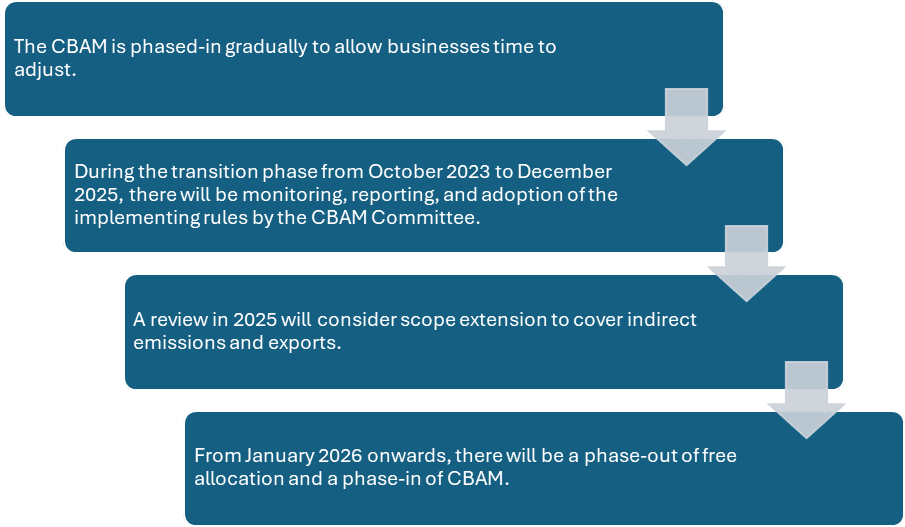
There is the gradual implementation of CBAM till January 2026:
|
Transitional phase (2023-2025) |
Review phase (2025) | Post-transitional [Definitive] phase (January 2026 onward): |
During the CBAM transitional period, the following objectives are outlined:
During the transitional phase, CBAM reports must include:
Sectors and criteria in the first phase:
Selected on the basis of 3 criteria:
|
The Commission is tasked with presenting two reports before the conclusion of the transitional period:
|
In the post-transitional phase starting from January 2026, a structured CBAM declaration process is established. This declaration will include the following key components:
This declaration is required to be submitted annually, providing comprehensive data on the carbon footprint associated with imported goods and ensuring transparency and accountability in the CBAM framework. |

References
- YIANNIS Z., WILLEM V., and LUC H. (June 2023); Understanding the impact of CBAM on chemicals: how companies can prepare for the future; Online Webinar.
- European Commission (May 2023); Carbon Border Adjustment Mechanism.
- European Commission (July 2021); Proposal for a REGULATION OF THE EUROPEAN PARLIAMENT AND OF THE COUNCIL establishing a carbon border adjustment mechanism.
- Gerassimos T. (February 2024); The EU Carbon Border Adjustment Mechanism: A new, green way of pricing carbon in imports to the EU; Plenary Stakeholders Meeting.
- Official Journal of the European Union (May 2023); REGULATION (EU) 2023/955 OF THE EUROPEAN PARLIAMENT AND OF THE COUNCIL: establishing a Social Climate Fund and amending Regulation (EU) 2021/1060 [66].